

Woman needs to log off but woman wants to be famous on the internet
My spirit is contaminated with microplastics and chatgpt prompts

A woman of the internet and unprecedented times lives in public servitude to the digital, with a slight disgust for the physical. Her corner of the internet is where good ideas go to die – where every thought meets its demise of overuse and commodity. She thinks she won’t implode when she logs off, but she’s never been taught anything else. What does ‘going offline’ mean to somebody who came of age inside the feed? To those of us still in pursuit of triumph inextricable from the computer screen? Frankly, to those who can’t afford a slower way?
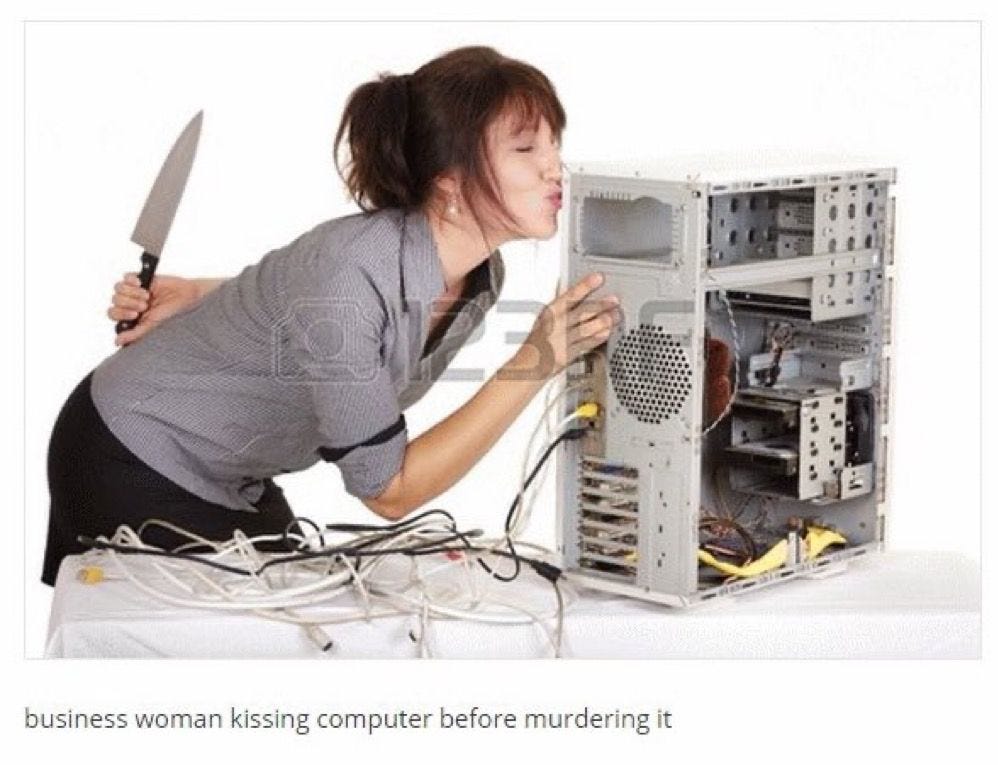
I am a 1998 child, hopeful and bright, raised on privatization and neologisms, glorifying the American mind through the post-soviet picket fence, edged for positive change that never comes. A child that knows the price of milk and eggs and the effects of cultural ambivalence. That knows presentation prevails over substance. Something looks good and new, so it must be good and new. In 6th grade, only four people in my class had smartphones. A few years down the line, we were putting the Valencia filter over our Instagram photos each on our individual iPhones, shaping the early look and feel of the very platforms that would later become surveillance playgrounds and techwealth goldmines. It was all cute and communal. I’ve always been a lucid dreamer, now even the most surreal dreams are pestered with my clicking through some sort of user interface.
We were both early adopters and raw material for learning, unknowingly helping write the new social contract. Our brain formation was parallel to spaces that taught us the world is to be viewed through the perceived self, not experienced directly through the senses. The symbiotic tie of desire to action was broken: there was a third party to consider beyond just yourself and what you wanted. Yourself, the world, and the computer. I want the whole entire world, but what does the computer want? And when I get there, will it still feel like sitting in my room with just my face lit up? I hope the computer is sentient enough to have my best interest. When I’m online, I feel surrounded, warm, included. Merged and tethered, degrading together.
To be visible on the internet today is to occupy a unique domain without the pursuit of uniqueness. Effortless vantage of an unpainted being with a painted life. A ‘distinct voice’ must be divorced from all the desperation and attempts it takes to carve one. At the same time, we’re obsessed with authenticity, with its deployment – often disguised as a certain unseriousness and afterthought of labor. The result is more output, more accessible intellectual commons, less focus on digestion and ownership. First come first serve, no edits, low stakes. Things wither before they’re fully metabolized, so even when we claim we want slowness, the winning solution is more of everything. “The rhetoric of authenticity partakes of notions of pure beginnings and implicitly denigrates what comes later, which is marked as corrupting or contaminating,” Erika Balsom writes. “The desire for authenticity is no escape from commodity fetishism but its apotheosis.” But it’s just the internet, it’s not that deep!
Of course it’s not that deep. Except it is. When anyone can put my essay through ChatGPT or Claude and replicate it in their own tone of voice with okay quality, I’m not convinced spending hours arranging thoughts and letters is the best use of my time. No one would dare to catch a cheat amidst en masse AI slop. “The word on the page may not reveal (may conceal) the flabbiness of the mind that conceived it,” Sontag once noted in her journals. I am no victim - I know what I’m trading. But it’s not like the fruits of my labor come in anything but pride and moral superiority: the human touch on things doesn’t make me richer or more talented, doesn’t grant access to anything beyond keeping my own cognition intact. Quality is hard to come across, but in itself doesn’t guarantee attention. I guess we crave a chokehold to a certain standard.
On the flip side of the pressure, something worse resides: being offline. You’ll be relentlessly advised to log off to preserve sanity. Disconnecting is the new luxury – that’s what a content creator with a tripod told me. If it’s a luxury, then I shouldn’t be too spiritually broke to afford it. The advice sits with bitterness in my mouth as many of us are still trying to carve a space for ourselves on the internet, tending to our work like it means something beyond content. ‘Going offline’ implies the existence of two independent self-contained spaces, the online and the offline, where one can be forsaken in favor of the other. Any person relying on their work being online will tell you that is not the case. They’re intertwined mediums: my presence online determines what offline looks like tomorrow. My trying is not for nothing, posting not optional nor a guilty pleasure. I can’t succumb to a line of thinking that leaves a lot to the imagination and nothing to reality.
Writing is the most selfish-selfless communication form there is. Words have a firmness and permanence to them. Art surviving in growth optics requires a healthy distance between thought and product, between the self and the computer, the boundaries of which are incredibly blurred. I’ve spent the last two years on Substack, watching the platform scale and change trajectory in real time, just like I watched Instagram scale and change over a decade ago whilst unknowingly serving as raw material of data, behavior, attention. My envy for those who managed to exit (or diversify) the rollercoaster strategically is green as ever. A lot of us are getting there or failing to – the balloon of grandeur has deflated. Yet, it’s not entirely up to us to ‘hack it’ – in fact, I think it’s harder to break through for the kids who, building the culture, perpetually helped build the machine itself. The algorithms are trained on our sensitivity, on our seeing ourselves as an extension of the platforms we say we want to abandon. We’re inherently at a disadvantage.
Beyond all this, I’m no complainer; I like being alive and grateful, residing somewhere between deep research and Ozempic ads, negotiating with the machine, not really understanding if I’m making something truthful or just nibbling on my own tail from one platform to the other. And if this is what it’s supposed to feel like, no matter the medium, then at least I can say I tried.
A tale as old as the web: woman is crushed under the weight of political unrest and microplastics. Woman is vain enough to care about money and popularity. Woman needs to log off, but woman wants to be famous on the internet. What’s woman to do? Roll around outside in the dirt? Or push through the chest pressure, reach her arm wide out for a 0.5 photo? Well, for starters, woman is to take a breath. She’s to decide what comes next. A manuscript, an exhibition, cultural decline, apocalypse, irrelevance. She needs to understand why she does what she does and keep her dignity away from the machine. Maybe to live generatively, maybe to outlive collapse, maybe just to demand a better process of herself. Maybe to find out one of her most beloved artists is a subscriber. Little things can be big things. Long live, woman of the internet! Stay with us, stay online, stay safe.
P.S. I’m hosting another workshop in Amsterdam on January 24th with my friends at Pilot Magazine to celebrate the launch of their new issue You Are Here, which features my essay what the hell, sure. RSVP via my DMs - it’s free to attend!
as a woman who is literally, at this very moment, planning a solo "offline" weekend and will also be spending all week very much online, all of this. I keep thinking about what Liz Gilbert writes in Big Magic, "the paradox of creativity is that it matters deeply, and also it doesn't matter at all." trying to hold it lightly, trying to take it very seriously. trying, trying. at least we're trying.
this was SO brilliant and describes a feeling i’ve tangled with for years as i endlessly delete and redownload instagram/tiktok. I love what you said about “negotiating with the machine” and biting your tail, such good writing. i’m a 1998 baby too and it’s so difficult to discern where our agency ends and exploitation begins