

buying anything to feel something
save me, rhode lip treatment, save me

(The following essay is a reworked piece previously published on my Medium)
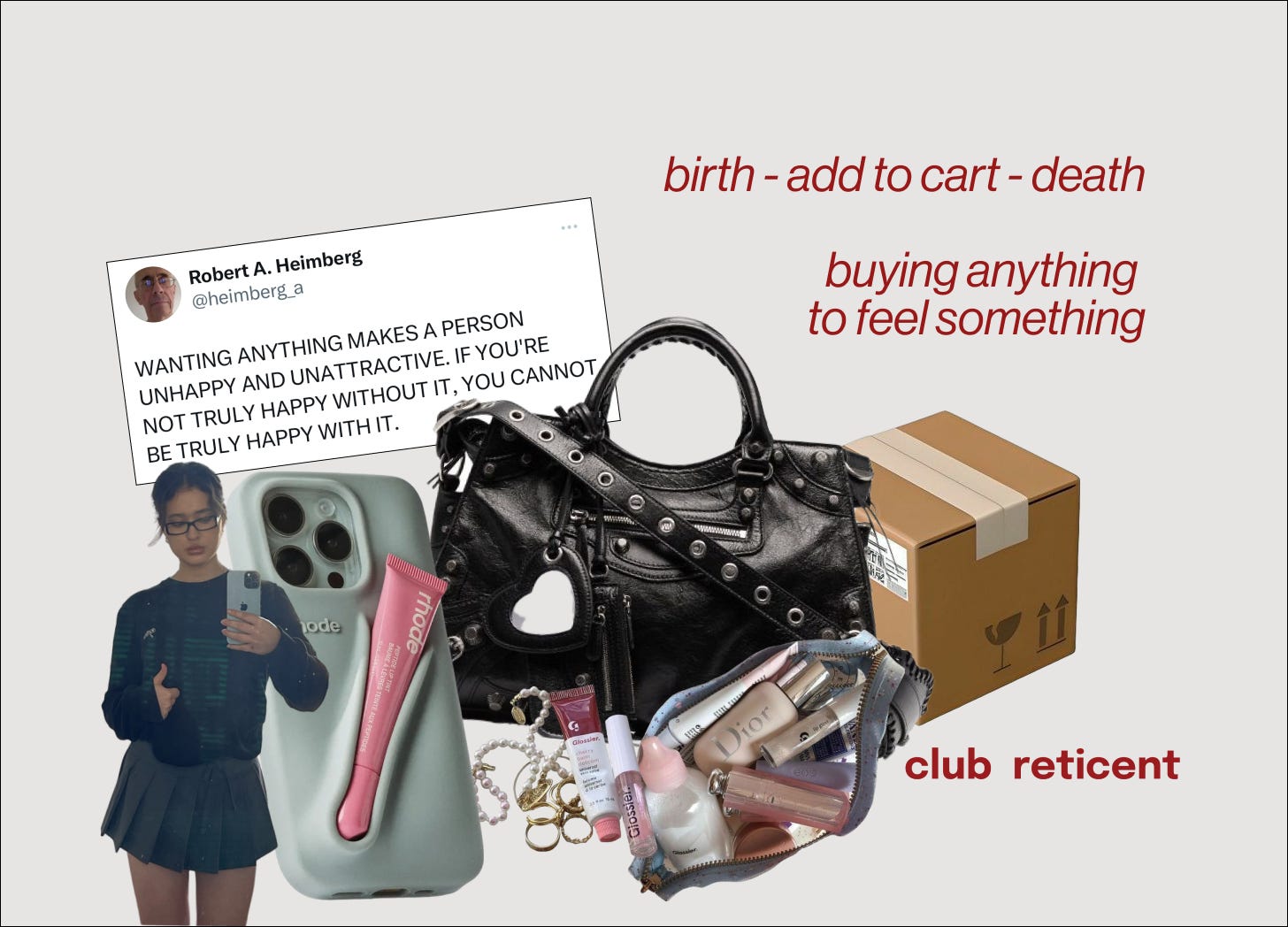
The list of things I love more than a freshly delivered package, patiently waiting for me at my doorstep, is very humble. Better yet, I don’t think I could name five activities off the top of my head that ignite my primal brain more than the scroll-buy-receive chain reaction. Getting a package is exciting, erotic, sexy, and so freaky—a flirty dance between me and my credit card. What once was a hopeless yearning for an object, dreary separation by a laptop screen, is now a reality in a beige box, waiting for me with love and loyalty. My package is more than just a package: it’s a symbol of the 21st-century woman, my independence and autonomy personified. Look, I earned the money, and I chose to spend it on the contents of this stupid box. It’s mine, not yours. In a sense, buying something feels like an act of rebellion against both the patriarchy and my lousy financial literacy as someone who grew up without money—but who’s the villain I’m rebelling against? I’m doing precisely what companies want me to do if not more: biting their offers and discounts with no critical thinking involved in the process. As a marketer, I sometimes feel embarrassed about how easily I fall for this trap again and again. But as a woman living in 2024—as in trying to survive and have a meaningful life—I understand why I’m such an easy target and even hold space for self-compassion in between my frivolous spending.
I buy a lot of shit online. When I’m not actively shopping, I’m doing it passively: even now as I’m typing and staring at the screen, I have Depop and Amazon tabs open looking for nothing in particular. Capri pants. Carhartt jacket. Prada loafers. Vintage Balenciaga City bag. I’m probably not going to buy any of these, but it feels good to scroll and save. I do my due diligence when it comes to avoiding obvious vapid trends, the lifecycle of which will run out before my package ships—I’m lucky to have skipped the Stanley Cup craze and Rhode lip treatment extravaganza. But that was only thanks to my juvenile conviction I’m inherently ‘too cool’ for anything viral—not because I’m actually any better or smarter. My obsession is slightly less outrageous on the consumer scale compared to the gigantic borderline-hoarding beauty hauls you see on TikTok, but that doesn’t make it any less dangerous: things tend to add up, as we know. Living with a perpetual inclination to compulsive purchases isn’t a lifestyle choice, really: it’s plain stupidity that leads me nowhere but to an overflowing closet, a dozen lipsticks of the same shade, and depleted disposable income.
We’re living in strange times: the desire, urge, and social pressure to consume are as strong as ever (thank you TikTok Shop!! Thank you, Amazon! And a special shoutout to Pinterest!), and bombardment with targeted ads is getting more and more aggressive, yet our limitless rising cost of living makes it hard to make ends meet. It’s like we’re not only disconnected from economic circumstances at large but disconnected from our wallets, too. Let’s address the elephant here: we’re all collectively broke right now. All of my friends, whether in tech, finance, or hospitality, are saying they’ve never felt poorer. The wages are stagnant and aren’t keeping up with rent, $7 coffees, and basic grocery runs. Little treats aren’t even little anymore. Therefore, each purchase outside of your necessities is met with inner resistance, as you tend to second-guess whether you need it or not. But dividing things by “need” and “want,” I find, is such flat, boring, and not for the girlies advice… It’s too subjective of an assessment that can’t be relied upon when it comes to financial decision-making: sure, I don’t need these Dolce & Gabbana glasses just because I like Gabbriette and subconsciously want to mimic her. I’m not going to die if I don’t get a new perfume. But do I need to feel something, anything at all? Do I need a temporary escape from my 9 to 5 and the emotional burden of living in late-stage capitalism and the unlikely prospects of my life ever progressing past the rise and grind stage? Do I need validation from strangers online? Do I need my loyal story likers to shower me with attention? Yes, I do need all of the above—and I’m not ashamed to admit it. In fact, I fear if I don’t get that immediate relief, I may as well not do anything at all—what’s the point of working hard if I can’t even reward myself with momentary joy? Instant gratification cannot be frowned upon when it’s all we have.
The psychological factor of "I Buy Therefore I Am" also plays a big role. We’ve gotten ourselves into a lot of trouble since we began forming our identity, online and offline, around the things we buy. Worse, we’ve allowed corporations to manipulate how we feel about ourselves based solely on our purchases. Because the stakes are higher now: there is an added factor of storytelling on a scale we haven’t seen before. While our millennial and Gen X counterparts are satisfied with a nice martini glass set for home gatherings and early morning mimosas, we must show it to the world: post it, reel it, tweet it, broadcast it, tag the brand. Purchases for the self are a thing of the past, and what you buy is for the whole world to see. The lines between consumption and connection have blurred: everything is a core, a lifestyle, a prism through which we see ourselves—maybe the only way to belong and be seen by others. Exerting our poor neurotransmitters into obscenity, we now directly identify with Our Items—our individuality muscles outside of the consumption realm have completely atrophied. If we’re honest for just a second, we can collectively admit it’s not the Rhode lip treatment we want; it’s the narrative we create around ourselves and how the ownership reflects on us, our character, and our values. We want to feel like Hailey Bieber, even though deep down we understand nothing about her will ever come close to relatable or accessible to us. So we settle for the second best thing: the pursuit of embodiment.
When I try to get to the bottom of what drives my purchase urges, the answer is never straightforward. Sometimes it’s pure boredom or sadness. A little dopamine chase never hurt anybody, right? Other times it’s a different kind of sadness—a profound dissatisfaction with my life that slowly eats away at my sense of self and my confidence. It usually starts with doomscrolling and ends somewhere 'I’m not where I thought I would be at my age, I need to make a change ASAP'—not sure what happens in the middle. To offset this feeling, I turn to shopping. Purchasing something now becomes a means to an end, an attempt to invigorate my stale, emotionless interior by getting just an inch closer to the person I wish I could be. And since putting in actual work won’t yield immediate results, decorating my life with tangible items is a safer bet. Naturally, paying the price for my life to resemble something better and bigger than what I currently have—doesn’t matter that it’s only by proxy—is a virtue. Embodiment in lieu of reinvention. The reinvention I’m longing for is too far-fetched anyway (blame capitalism, beauty standards, or maybe my brain is just fried from too much Instagram), so a brief moment of satisfaction feels justified. The desire to feel like the woman I aspire to be is insatiable, and I’m ready to pay good money for the fleeting delight where my aspirational self aligns with who I am.
I don’t want you to assume that mindless buying is a strictly individual shortcoming because it isn’t. The machine at hand—consumerism—is bigger than all of us. It’s a ginormous scary organism our economy feeds on, and it’s working against us at every moment of every day. A near-impossible habit to kick. It’s not unusual to want things, and it would be almost rude to blame ourselves for impulsive decisions when all the stars in the world have aligned precisely to make the decision process as easy, seamless, and instantly gratifying as it can be. I mean, with an internet connection, free shipping, and a credit card, nothing is standing between you and the future version of you—the magical mysterious woman who has the item and the lifestyle you don’t have. But individual choices are just as much at play: if you’ve ever found yourself transferring from your savings to checking for an SSENSE purchase, this is a judgment-free space. But also, let’s think a bit more ahead and cautiously next time. I’m not proposing a revolution; I only want this to evoke a bigger conversation. Why are we buying so much tangible stuff in an attempt to resolve intangible issues? And how do we stop?
Earlier this year, I made a radical decision to start waiting 24 hours before buying anything online. Not the answer to my prayers per se, but it helps stave off the hunger and lets my frontal lobe do its job. Nine times out of ten, I end up not buying the item — so I’d say it’s a rather effective technique. I also transfer as much money as possible into my savings at the beginning of every month, deliberately setting myself up for less spending. Do I still want that Paloma Wool sweater I saw on sale? Maybe. Is it easier to resist when I know for a fact my brain is, once again, trying to create a narrative around my owning it? Do I crave the potential feeling owning something might bring me, even though there’s no guarantee? Well, yeah. Emotional context aside, I don’t even care about the sweater nor will I wear it more than a couple of times and hate my body the whole time I’m wearing it, so what even is the point? Understanding our motivations, as well as admitting to their absurdity, would be a great start on a path to conscious consumption and making use of what we already have.
While getting a package delivered just might be one of the simplest accessible pleasures of a woman’s life in this dystopian landscape with a bleak future, maybe we can slowly and en masse start to awaken to the notion that it’s not the stuff itself we’re after, it’s the feeling. It’s always the damn feelings at fault. And once we do, it’ll be easier to replace all the spending with more writing, talking, creating, thinking, or simply staring at the wall — anything that doesn’t cost money or collect cookies to use against our wallets later.
What was your latest useless purchase? Let me know in the comments.
with reticence,
Valerie
100% relate. classic bedroom girl-rotting until a delivery package arrives. 🦂🦂
you are literally inside my brain. this was perfect