

The Horny Woman Renaissance
what raw desire on the big screen tells us about ourselves

A woman that wants is a woman that terrifies. To the untrained eye, her wanting, an act equally sinful and moving, is a deadly spectacle.

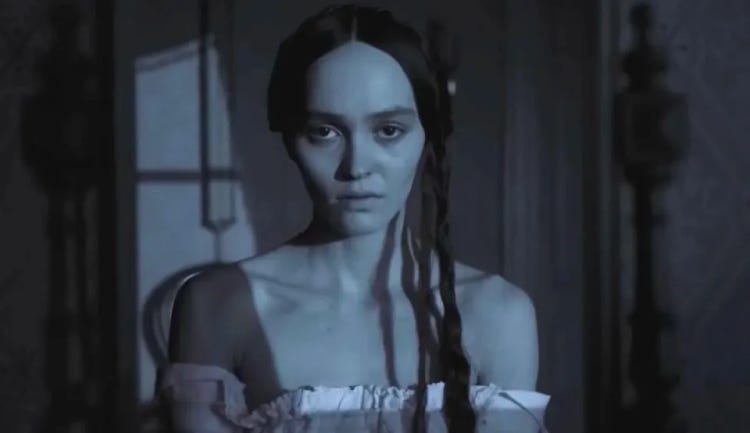
I went to see Robert Eggers’ Nosferatu and Halina Reijn’s Babygirl back to back. Two distinctively unique and layered stories, once stripped bare from their contextual and stylistic differences, are both tales of female desire and darkness. While one is a haunting cautionary tale explored through the occult where Lily-Rose Depp’s Ellen gets to reconcile with her shame embodied in an ancient sexy Romanian vampire, and the other is a layered contemporary narrative of power play with a level-headed CEO Romy (Nicole Kidman) willing to risk it all for sexual exploration, both are a meditation on the same question, one we never face voluntarily until we’re forced to: Who are we, as women, when no one’s looking? A consequential question arises from here: What are we to do with our insatiable desire? I was pleasantly amused with how the two works unintentionally intertwine. Naturally, watching both felt like a tumultuous lifecycle of acceptance through the screen that first takes root in discomfort, reaches the boiling point of self-disgust, and then morphs into liberation and ultimate freedom. It has to be said that the lure of such stories, and why we love watching them, is not in the vicarious living out our ‘dirtiest fantasies’ through the protagonists — that would frankly be a boring and sexist oversimplification. The allure of it all is our being forced, by proxy, to grapple with our own darkness, to make amends with our insatiable appetite we’ve spent our lives, most of our energy, and scarce resources aiming to tame, with an unconscious understanding it’s probably not going anywhere any time soon, as vital energy can only transform but never die out. The feral sexual desire that each woman experiences —stomped on in varying degrees informed by her upbringing, trauma, or the circles she inhabits, as well as what she’s internalized to be ‘true’ about herself— is an unspoken topic. Sex is not taboo; desire is. Understanding the difference is the first step.
In a world where women have been penalized for wanting since the beginning of time, (at the very least, since the first bite of the apple) witnessing a woman’s submission to her forceful desire, with the inevitable darkness of its nature, is a sight that changes you. Both Eggers and Reijn invite a rather raw, unfiltered look on the interplay of suppression and sexuality, and what that does to a woman’s life, morals, and psyche. Desire is of hunger’s nature — it can be suppressed and denied, but only for so long, and the repercussions of this abstinence are explosive and ruinous. But how cathartic was it to get to see a woman’s battle with the darkness of her interior on the big screen. I’m not the only one, right? Doesn’t it feel like a collective breakthrough? In both films, our attention is brought to the fact that the act of wanting is far from pretty or even empowering. In fact, unless it’s messy, shattering, and quite ugly at times —wreaking your family or causing the plague, your choice— it probably wasn’t candidly or fully explored. In Babygirl’s case, the destructive force of desire culminates in hurting those you love most, giving into tangled and inappropriate power dynamics, and sophisticated self-sabotage frontlines. In Nosferatu, Ellen has no choice but to merge with desire through a curse-breaking human sacrifice to the vampire — one that begins with confronting her shadow and the shame surrounding it, almost in classic Jungian style. Refusal to do so has lethal consequences for everyone around her. Both women’s wanting is not a matter of choice or a means to an end; the wanting itself is the ultimate destination — equating the discovery of one’s desire to the discovery of self. A woman in pursuit of her wanting, after all, just might be a woman in her truest form, be that hunger or sexuality. It’s the only state in which you’re free to submit to what your body demands of you, hijacking the confinement of womanhood, which is typically about the exact opposite: what you demand of your body. A force simply too grand to care what is feminine and what isn’t, transcending sexism, prudishness, perception, and all the learned behaviors that stem from the above. I know you’ve felt that primal, ruthless desire in your own life, and how simultaneously holy and satanic it is. Happens to the best of us.
A contrast that has always been fascinating to me, and something I’ve struggled to understand about my own sexuality, is that a man’s desirability mirrors his desire: his active wanting (pursuing, making a move, courting with a brave approach) makes him, in turn, more attractive, rewards him with reciprocity. To want is an act, noble and masculine. This state of decision and pursuit (even in the origins of the word: the original notion of ‘lack’ was early extended to ‘need’ and from this developed the sense ‘desire’) is something our human nature understands easily: a relationship between predator and prey; object and subject. The opposite, however, is true for women: our own desire is reprimanded, looked down upon, and thus suppressed into the corners of our thinking. If you want to be desired, you cannot also desire at the same time — a woman is merely an accomplice to a man’s wanting. One if a driver, the other is an exemplary passenger seat. A woman that allows herself to be desirable is not the same woman who desires: those are polarizing forces and don’t have anything in common. If she cares to be wanted, she’s not actively displaying her own desire; instead, she’s dubious, strategic about her seduction tactics, lays plans out like a game of chess. She tricks the other party into taking the lead, and if she dares to let the vulgarity of her wanting shine through, she automatically becomes less desirable, her attitude less commendable. There is now ‘less’ of her to conquer, to take, to own. Such is the unfair paradox — and we’re led to believe it’s somehow empowering.
(That is not to claim queer women aren’t cornered into the same dichotomy — if anything, queerness just adds an additional layer of oscillation between wanting and being wanted.)
To assimilate why wanting is shameful for a woman even privately, we must take perception into account. A woman’s active desire for a man (or another woman) removes the third party — the pesky spectator living in each woman’s mind, a male observing her actions. It’s safe to presume that the observer living in our heads is part of the reason why we, both you and I, have always been secretly ashamed of the way we want people, even when nobody’s around to witness or punish us; held down by the weight of our appetites in favor of passive longing or yearning, a state so docile it feels safe and familiar, our second skin we’ve grown accustomed to. Because wanting sex is crude and unfeminine, we can’t risk being judged from within as much as by the outside world. Sandra Lee Bartky in Femininity and Domination put it best: “In the contemporary patriarchal culture, a panoptical male connoisseur resides within the consciousness of most women: they stand perpetually before his gaze and under his judgment.”1 Wanting, as an act of a woman, removes the male spectator in your head, leaving no place for him in the equation, and establishes a direct link between yourself and the object of your desire. And we’re just not used to seeing — or living — that way. Since our wanting is never rewarded (often the opposite) there’s no benefit of acting on it. This has helped me understand why female longing and yearning can get so aggressive, almost manic, delirious at times — it is nothing but disguised sexual desire bursting under the right amount of pressure and submission, a passive state that wants to turn active but doesn’t know how to. When asked about the non-performative nature of the sex scenes in Babygirl, Reijn said “When we look in the mirror, we look at ourselves through the blueprint, which is a straight white male, and we forget ourselves. But how would I look at myself if all of that would be gone? What would I wear? How would I behave?”.2
Being sexualized and perceived as an object of desire can never be mistaken for the act of desire itself: it’s a state as sterile and sanitized as the most puritanical of doctors ordered. You might notice this around you: we live in a paradigm of a hypersexual society that is also completely devoid of sex; everyone is naked and flashy but nothing is sensual or erotic. Nothing turns you on when you’re not allowed to want. Nothing is arousing when you’re meant to sit still and wait to be chosen. Our understanding of a woman’s relationship to sex is, unfortunately, devoid of desire completely — at best, it’s just reaping the rewards of being desired. But what did we expect from a society that suppresses appetite —another form of desire— with injections?
One could argue that women have already been granted the unequivocal right to sex that men have, with all its implications thanks to the sexual liberation we’ve undergone as a society. What more do you want, you dirty woman? I couldn’t disagree more. Here’s a ready-made idea for you: the “sexual liberation” in question has changed our relationship with sex, but not with desire itself. It has given us consent, but not the power to desire actively. It has only granted us safer conditions to be wanted in, and that is not the same thing as letting us want. Gaining the autonomy of our bodies has resulted in our ability to dictate and select how, where, when, and by whom we’re being desired, but it hasn’t turned the switch on from a passive to an active desire. Susan Sontag in The Third World of Women writes “Without a change to the very norms of sexuality the liberation of women is a meaningless goal. Sex as such is not liberating for women. Neither is more sex.”3 And there you have it: during my screening of Babygirl —mind you, I live in one of the most sexually liberated cultures in the world— the audience was gasping and closing their eyes during an uncontrived scene of Romy having a grunting, ear-piercing orgasm, namely for the first time in a long time. Would they have the same visceral reaction watching a man climax on screen? I doubt it. Everyone loved the bathtub scene in Saltburn, for instance. Checks out: how dare a woman enjoy herself sexually if her desire is feral, near-animalistic, perverse, and not at all passively feminine, pretty in pink and covered in lace and ribbons? The sexual liberation has gone as far as giving us the right to enjoy sex, but only as long as our joy is civilized, normal, not too strong or possessive, still abiding by the terms and conditions of the feminine. You can come, but the preservation of your dainty purity comes first. Ha.
Our resistance to female desire is not a myth: look at the uproar Sabrina Carpenter is causing with her public persona, her lyrics, performances — she’s an embodiment (perhaps too glitz and glam and serving to the masses, but still) of an open conversation about sex. Even in her pink and glittery entourage, her desire is bold enough to have caused a ripple of reactionary thinkpieces on the vulgar nature of her brand and how she’s ‘ruining the kids’.4 Most of the discourse, naturally, stems from jealousy —what’s new here— but regardless of the intent, all the Stepford University graduates have come out of the woodwork to let Sabrina know that her wanting is too much and horniness must stop now. A crystal clear projection if I’ve ever seen one.
There’s another, more insidious element that prevents us from wanting: desire and control are not a good match. Admittedly, nothing’s more threatening to a woman than a loss of control she so diligently guards. A body that desires is a body that meets its needs. So much of a woman’s journey, after all, is about suppression and rigorous discipline: controlling food intake, controlling her emotions, regulating and concealing, constantly exercising a certain prevention of destruction or doing damage control. Sandra Lee Bartky wrote: “This disciplinary power is peculiarly modern … the disciplinary techniques through which the ‘docile bodies’ of women are constructed aim at a regulation which is perpetual and exhaustive — a regulation of a body’s size and contours, its appetite, posture, gestures, and general comportment in space.” But when your desire in itself, as an active state of wanting, is the destructive force in your body, like the beastly appetite you develop once you’ve skipped one too many meals, unable to be tamed, only to be given into, letting it run free is incompatible with incessant discipline. A turning point from cinematic to gruesome, control doesn’t stand a chance where desire is acted upon. In the words of Halina Reijn, it’s okay to be feral — but do we really mean it if we can’t even handle female orgasm on screen?
“I am an appetite,” the vampire tells Ellen before she surrenders to his embrace, “Nothing more.”
There is a beast inside every woman that is no beast at all. There’s no morality to it — it’s just an appetite to be satiated, an active state of sexual desire. We perceive it as morbid because we’ve spent our lives, generation after generation, suppressing it. What happens if I let it out? is too terrifying of a thought, especially with its potential repercussions, main one being the threat of becoming less desirable, shamed for your very human nature. But at some point, we must realize that everything we’ve known about sex, desire, wanting, and our relationship to the aforementioned is wrong. We won’t enjoy sex until we enjoy our bodies. We won’t enjoy our bodies until we stop clawing for control, allowing desire to step in. The sexual liberation hasn’t given us permission to desire — it only permits an ownership of how we’re being desired. The major oversight of most sex conversations meant to empower women is that it’s in the wanting, not in the being wanted, that life is found. Desire is the closest you can get to the source of yourself — in fact, it may as well be our only shot at getting to the very bottom of who we are. And if destruction happens on the way, at least you’ve lived an opulent life. To quote one of my favorite reviews of Nosferatu, the prudes are dead men walking, only the horny truly live. The question is, are you brave enough to want?
___
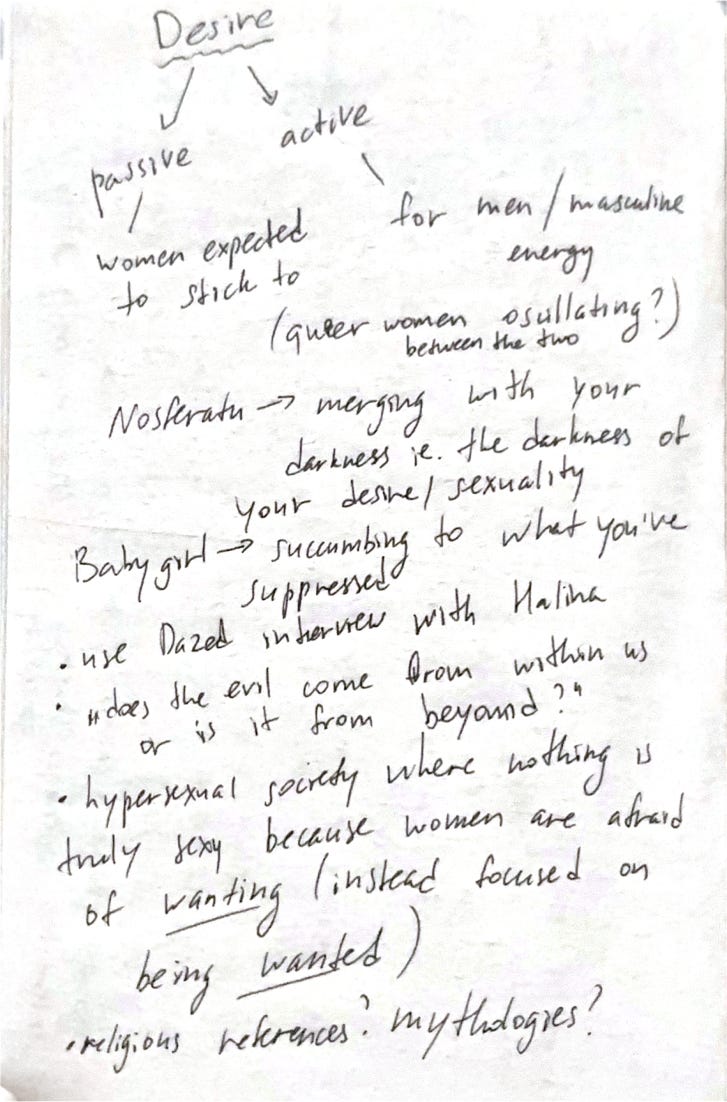
This is a free essay but I wanted to offer a paid bonus — here’s a scan of my planning out the piece in my journal. I always try to schematically elaborate on an idea by hand before I start working on it, and I highly recommend doing so. Hope this offers a fun glimpse into the process! Thank you for supporting my work!
this one left me nearly speechless. just so so so good
this is absolutely everything i ever could have wanted.. so brilliant as always 🤍🤍