

Allie Rowbottom
How to publish a novel without compromise, the industry’s purity culture, and advice Maggie Nelson gave her at 23


The Grit is a Club Reticent series where I have beautiful conversations with my favorite women about their creative lives – unpredictability to craft.
As someone geographically removed from the American lit landscape, I tend to be, in a very European out-of-office sense, late to the game. Having given up on seeking new books via listicles and reviews, I stick strictly to my friend’s recommendations and spontaneous finds. I have a deep belief that if a good book is meant to reach me, the universe will find a way. A meet-cute did happen here: Allie Rowbottom messaged me to see if I’d be interested in an advance copy of her new novel, Lovers XXX, about two aspiring artists Jude and Winnie who get submerged into the underworld of porn in 1980s Los Angeles. Beneath the drugs and sex, this is a novel about friendship, identity, and a woman’s continuous becoming.
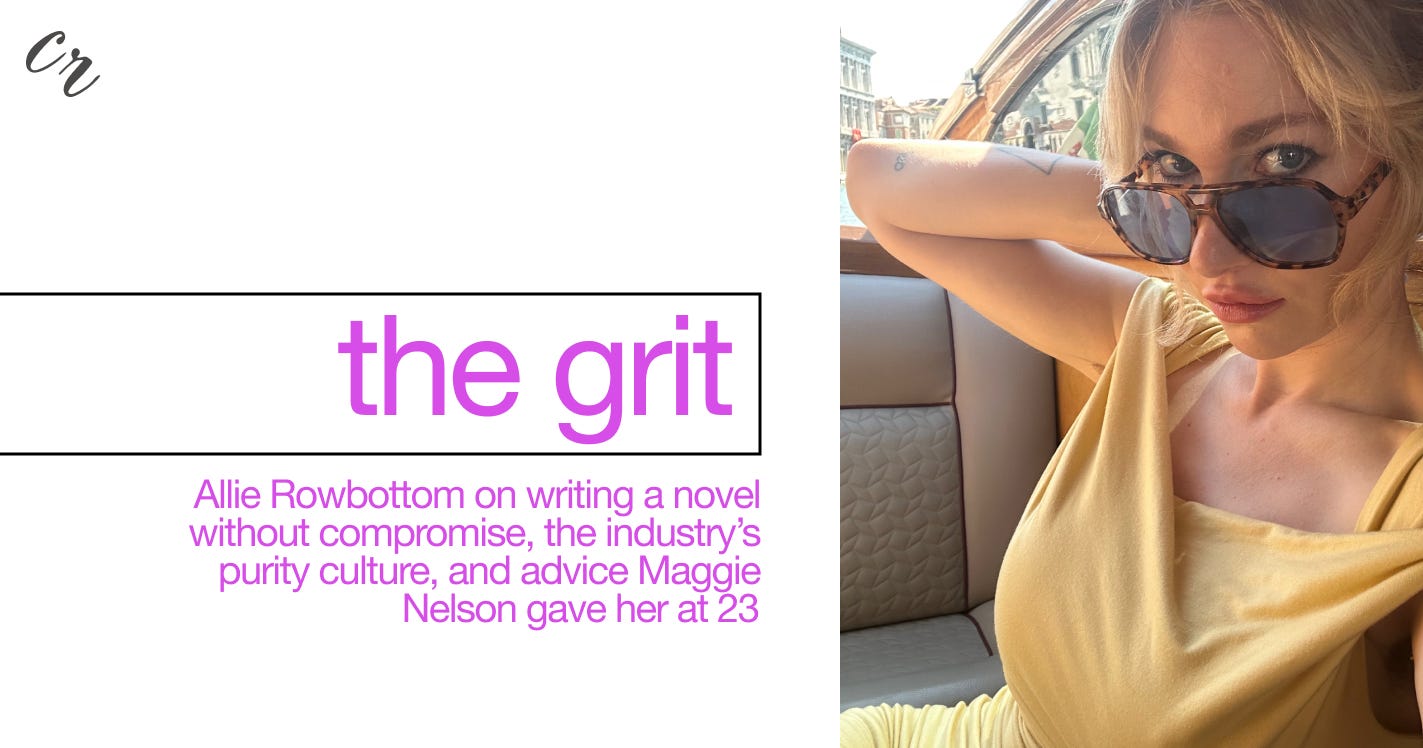
Things have come full circle, and today Allie is our honorary guest. She walks me through her writing process, leather and lace truths of a plot, the importance of not rushing, assures me that my spiraling as a debut novelist is essential, and talks about distribution hangups that –shocker– still happen to an established, beloved author. Allie’s candidness is a gift.
Valerie: Congratulations on Lovers XXX. How do you feel about it now that the book is out in the world?
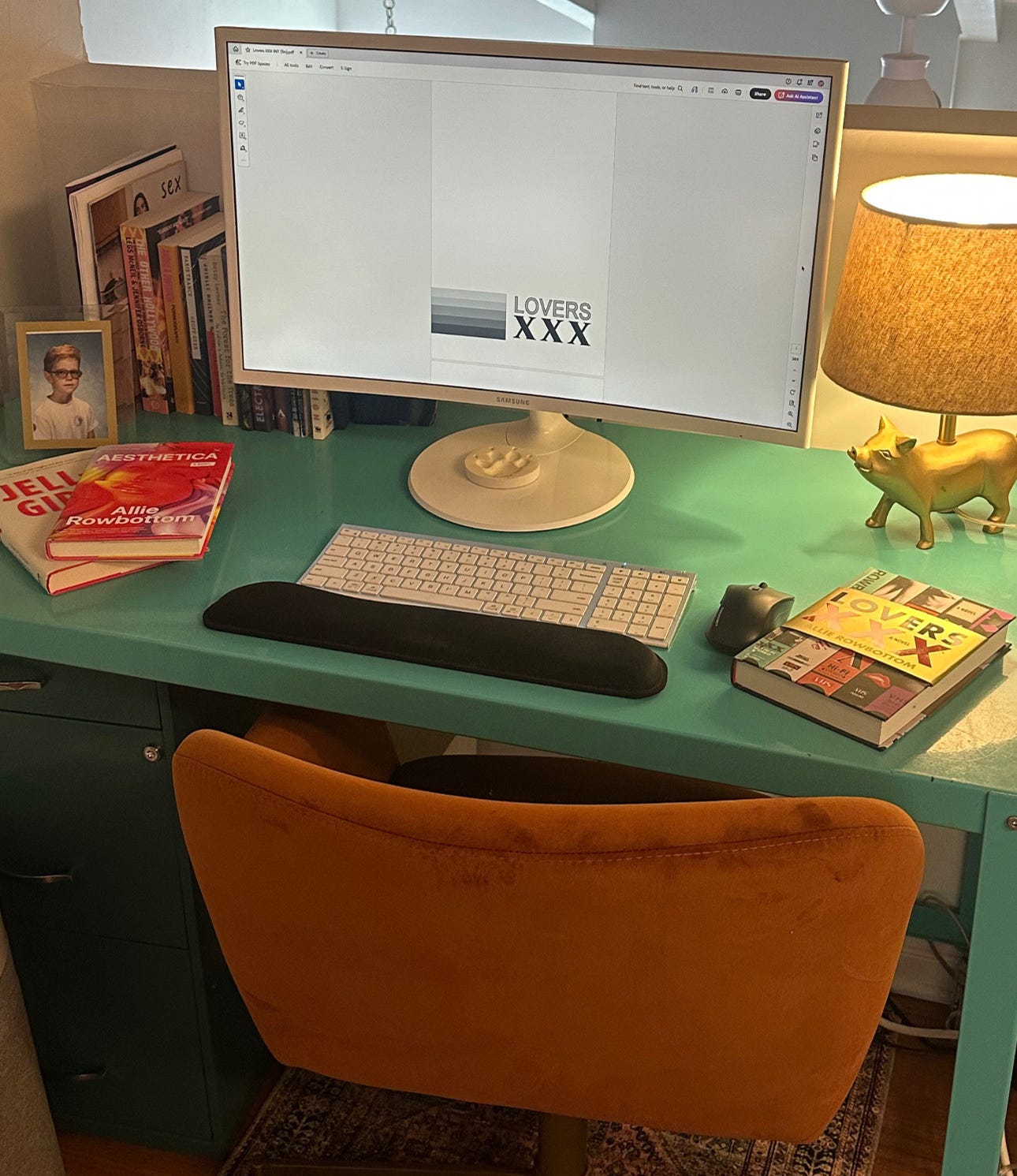
Allie Rowbottom: I feel so good. I loved writing it and I loved what came out. I felt very channeled in a way – the writing process was really fluid and easy. And I’ve had a great early publication cycle. But there are so many highs and lows when you put your work out there to be consumed. I sort of miss that time when it was just mine, when I was working on it and it was my world and no one else’s, and I was delighting myself with what was coming out. It’s obviously so amazing to hear people love the book and respond positively to it, but then I’ve also been dealing with some distribution hang-ups, which is not so fun. So the writing is the best part.
V: How would you compare the emotional, mental, and spiritual journey of writing this novel as opposed to your debut novel Aesthetica?
AR: I had published my memoir Jell-O Girls before Aesthetica, but writing a novel is so different from writing a memoir, and writing fiction is so different from writing non-fiction. So Aesthetica was my space to teach myself how to write a novel. And I’ll admit, I was in a rush to figure that out, to have a second book, because–again, with the highs and lows–publishing my first book was emotionally challenging. In a way, I really wanted a do-over. I was like: I just have to write another one so I can have a better experience this time.
With Aesthetica, the rushing held me back. It was a more fraught, tortured writing experience. It was: can I do this? Will I have a second book? Can I prove to myself and to everyone who I feel doesn’t believe in me that I can do this? All those chip-on-your-shoulder, negative voices were really strong. Publishing the novel silenced those voices (for a time) and cleared the way for me to write this one. Aesthetica had done well, and that success gave me the confidence in my vision and my ability to execute. I just rode that wave with Lovers, and I think it really served the book. It was such a fluid writing experience.
V: I’m working on my debut novel right now, and I think I can relate to your process with Aesthetica. Was the rushing more external or internal? I feel like I’m running out of time constantly, like I’m indebted to it, and it’s not the greatest place to write from.
AR: I think some urgency is good. It’s good to get things done, to have that fire under your butt. But then there’s a tipping point where it ceases to be useful.
V: Agreed. And how do you know when the draft is done? Is it a natural conclusion, an arrival, or a really hard deadline?
AR: With fiction, having a deadline can definitely be good, but in my experience you can’t really rush the ending, and you can’t rush something to being finished. A lot of the time what determines that the book is finished is an emotional aha, a moment between the book and its writer that can’t be manufactured. With all of my books there has been a memorable, tangible moment when I’ve written the ending – I can remember the feeling of writing the ending of every book and being like, I get it now.
V: That must be a beautiful feeling. I’ve never experienced that.
AR: You’re going to get there. You’ll feel it, and then you’ll know.
V: You’re someone who refuses to conform or mold your work to appeal to the masses. I find that very admirable. This must bring on a set of difficulties, too. Regarding the distribution hang-ups –Barnes & Noble not displaying your book in any stores– was it something you were prepared for?
AR: That’s a great question. I think I was vaguely, intellectually aware that this subject would be really activating for some people, media outlets and, in this case, booksellers. But I didn’t know it; I didn’t quite believe that in 2026 the topic of porn would be this taboo, because the porn industry is so omnipresent. Everywhere I go in New York, and even more so in LA, everything feels and looks like porn. I wasn’t emotionally prepared for the cognitive dissonance of censorship in this landscape.
Nonetheless, I know that I’m getting a taste of something that adult film performers and sex workers, historically and currently, have to deal with all the time. It’s not as bad for me as it is for them.
V: I find it disingenuous and ignorant that there are so many books on bestseller shelves with quite harmful ideologies, but since the authors know how to bypass those guardrails and package dangerous subject matter nicely, it’s all good. Yet something more outwardly explicit is censored and penalized. I would hope the publishing industry –of all industries– possesses the depth and the nuance to understand these things, but seems like it’s still too much to ask for.
AR: I agree, it’s bizarre – you go into Barnes & Noble or any bookstore, and the romantasy genre is huge and, as I understand it, quite sexually explicit. Yet the covers are infantilizing. They look like children’s books. People want the pleasure of reading erotica–and no shame there– but want to be shielded from the larger machinations of erotic industries, or the realities of pleasure itself, or even desire itself. Culturally, it seems like people are retreating from critical thought: we’re getting more averse to nuance, because the internet foments black-or-white thinking. It’s easy to say something is good or bad instead of having to sit in the grey area between those things, which is where all good questions come from.
People want the pleasure of reading erotica—and no shame there—but want to be shielded from the larger machinations of erotic industries, or the realities of pleasure itself, or even desire itself.
V: But then how do you evade that pressure to conform? When you know what’s digestible, what’s easy, what sells. How do you still maintain that integrity?
AR: I didn’t write this book thinking it was going to be a bestseller. I thought: this is what I want to write about. I might, in the future, not write about a topic as taboo as porn, or even plastic surgery. But I’ll never write about something in a simplistic way, or pander to a reader’s desire to moralize or judge a character.
It’s important to note I’m lucky to not have to fully depend on my publishing career to make a living. So I’m in the position where I get to choose what’s going to make me happiest at the end of my career and the end of my life. I would love to have the experience of having a bestselling book and enjoy interacting with tons of readers –I think most writers want that– but if it’s between that and compromising myself artistically, I’m always going to prioritize what I think has the most artistic merit. I’m never going to put the marketplace first. It wouldn’t matter if I had a million readers – if I’d written something I didn’t fully stand behind, it would feel dissatisfying to me.
I’m never going to put the marketplace first. It wouldn’t matter if I had a million readers – if I’d written something I didn’t fully stand behind, it would feel dissatisfying to me.
V: I understand. In your recent interview for Cultured, you mentioned you feel less pressure now to be palatable, to be a certain type of author. Do you think that’s more of a “finally” career milestone, or a natural evolution as a person and as a woman – growing into yourself, discovering who you are?
AR: I think it’s both. I’ve been around long enough to see that sales and awards do not necessarily correlate with artistic merit. Many readers have the experience of sitting down with an extremely hyped book – and then going, this is it? If you see that happen enough times, you realize the things you maybe thought you wanted when you were starting your career don’t have the same meaning because they’re doled out politically, or they’re about marketing, or whatever else besides the work itself.
And then, yes, it’s also just the path my career has taken. I steered this ship. I didn’t always know what I was doing, but I steered it by following my intuition and wanting to write about things other people don’t talk about, or in ways other people aren’t talking about them. This is where I ended up, so I accept it.
V: You said something in an old interview of yours that moved me so much, I wrote it down: “the plot must do everything in its power to reveal and push from the character the emotional truth of the book.” Does that still stand true to you? And what were the particular moments in crafting the Lovers plot where that felt true?
AR: Oh, great question. Yes, that feels very true to me – it feels like the purest understanding of plot. There are books out there that are all plot, and those maybe fall more into genre categories, like thrillers (not to say there aren’t literary thrillers). In those super plot-heavy books, the plot can just be plot; it doesn’t require deep revelations from the characters, or push the characters to become their truest selves. But in literary, plot-driven fiction, the story and character are inseparable.
In Lovers XXX there were so many moments like that. It’s a pretty intricately plotted book. A lot of the pressure, especially in the first half of the book, comes from Jude’s relationship with Laird. He’s kind of an annoying character, but he does a lot of work to push her to figure out what she wants. He’s also the catalyst for her deciding to do porn, and that becomes a turning point as well. So maybe as an addendum to my quote: character and plot are inextricable. Characters not only drive plot, they kind of are plot.
V: When writing Aesthetica, you rewrote the ending multiple times to land on something you were satisfied with. Could you walk me through that journey?
AR: I had to write a bunch of different plots for that book – I was rushing and figuring out how to make a novel happen. What I discovered as I tried and failed is that I had to slow down and get to know my character: what was it about her that was compelling to me in the first place? Not just what she wanted, but what the characters around her wanted, and what that could tell me about what this book was deeply about. It’s about plastic surgery and influencer culture on the surface, but what it’s really about is identity, performance, and mother loss, the loss of girlhood, which is taken away from us by image culture and patriarchy too soon. Initially, the book was doing none of that. I was just writing a buzzy novel that pushed buttons a little bit with the plastic surgery stuff. Then I thought, that’s not the kind of writer I am. I’ve got to go deep on the emotional things that are sincerely compelling to me.
Then I thought, that’s not the kind of writer I am. I’ve got to go deep on the emotional things that are sincerely compelling to me.
V: How do you approach the emotional truth in your writing? Sometimes I feel like I’m negotiating with my truth and its depth, keeping things safely on the surface. I’m not sure if it’s a fear thing or a woman thing.
AR: It’s probably a human thing. I suppose it depends on the kind of novel you want to write. I always tell myself: you’ve got to go there. Get down into it. But weirdly enough, depth and truth are subjective. I remember seeing a goodreads review of Aesthetica that said “she only scratched the surface of these themes.” And I thought that was such an interesting craft dilemma. If you really go deep on every subject of the novel, you end up with a very long book. Is that the best vehicle to deliver the story? Sometimes, the best mode of delivery means not spending quite as many pages delving into the emotional truth of this or that. And sometimes, keeping it briefer gives the reader space to start asking themselves questions that will help them get there in the long run.
V: Fascinating. That means we all have different expectations going into a book. So what is depth, really, and how do we measure it?
AR: That’s the question. I think the only person who can determine the answer is the writer. You, as the writer, have to feel like this book is the execution of your vision, that it is what you wanted it to be, that you’ve said everything you wanted to say about this topic, and you feel done. That’s the feeling when you’re done: I’ve said everything I needed to say. Reading is just so subjective, more now than ever, I think, because the internet has democratized taste. So there will always be people out there saying you’ve failed. Which just makes it all the more important to have that private moment before the book is printed, where you determine for yourself that it’s what you wanted it to be.
Reading is just so subjective, more now than ever, I think, because the internet has democratized taste. So there will always be people out there saying you’ve failed.
V: How do you feel about the fact that everyone’s a cultural commentator/strategist/tastemaker?
AR: Honestly, I have a PhD in literature, and I would never rate someone’s art on a scale of one to five. I find it bizarre. I guess it’s good that people are engaged and want to share their reading experiences, but I find the impulse to rate almost anything that’s not an appliance, strange. But, hey, everyone’s a fucking expert apparently.
V: I find this common thread across your career and the interviews you’ve given: you’ve always been pretty open about the publishing process. Agents, readers, reviews, the marketplace at large. Where do you think this transparency comes from?
AR: It’s funny – as a person, I’m actually very conflict-averse. But I do feel like a bit of a contrarian and a button-pusher when it comes to systems I see as disingenuous. I’m sure that’s just any industry predicated on selling art. When I published my first book, I played the game. I was so well-mannered about the whole thing, buttoned up and deferential. But there’s a lot of bullshit in the publishing industry not built around taking care of, protecting, or benefiting writers. It’s really hard to make it as a writer, and even harder to feel supported – in a way that to professionals in many other industries would be appalling. There’s a culture of silence around it because people want to continue being published. It becomes this thing where nobody wants to talk about the challenges or the difficult truths.
So if I can help other writers who are starting out, and speak a little truth to power, I’m going to do it.
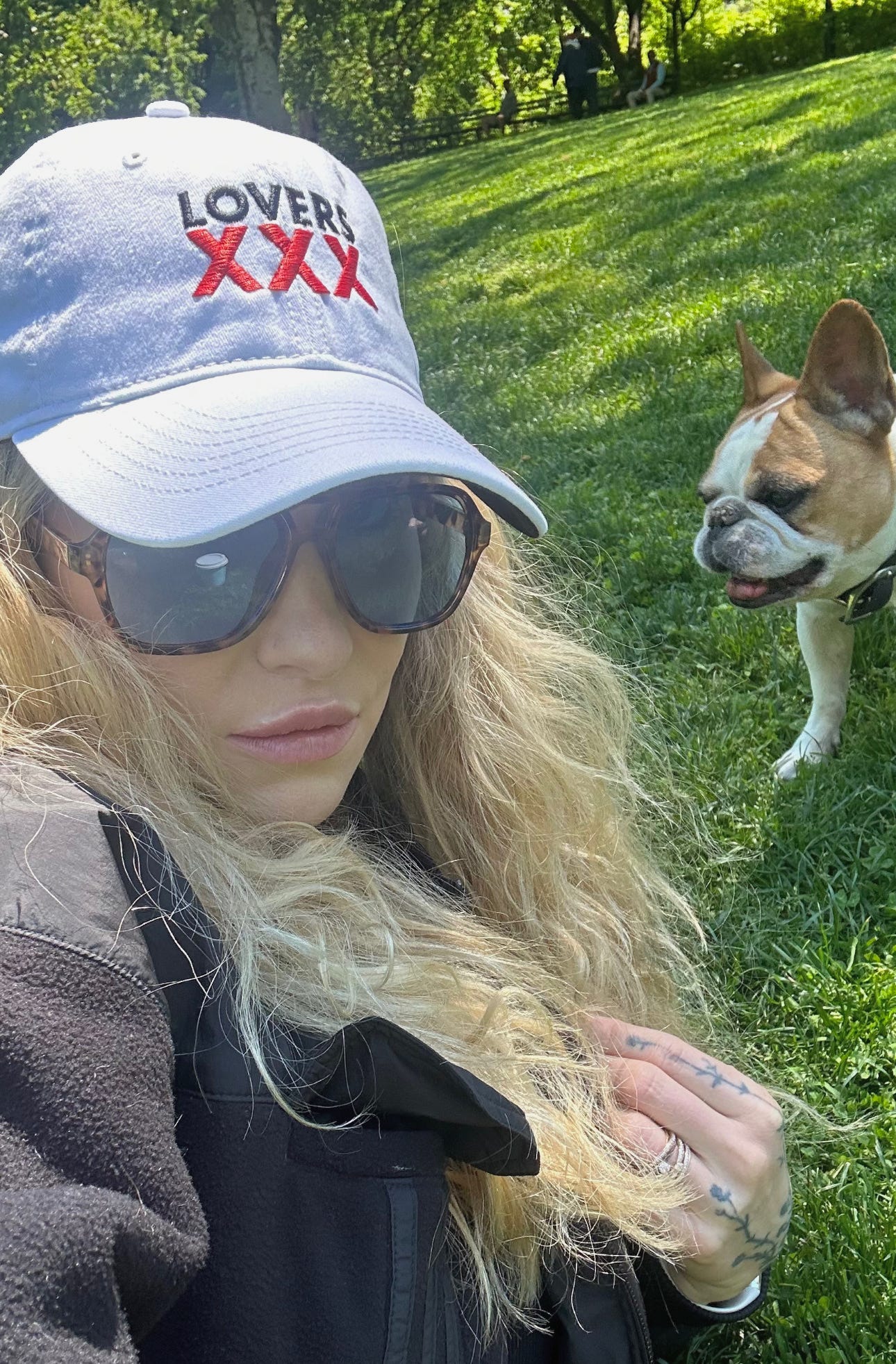
V: I’ve had conversations with people in the industry who don’t get my vision, and they felt the need to let me know that in less than kind ways. As a young writer, I felt so disempowered. One of them on a call was like, “I don’t really see this angle of a modern woman. What is a modern woman?” And their own website hasn’t been updated since probably 2004. I felt like, man, what a waste of time to try and explain to you the concept of a modern woman.
AR: God. I remember somebody passing on Aesthetica and saying, “I don’t see how plastic surgery and feminism connect.”
V: That is the consequence of being ahead of your time. You mentioned that Maggie Nelson was your mentor – must have been the greatest time ever. Do you remember any striking moments with her, or something she said that made an impact?
AR: I was 23 when I studied with Maggie, and it was a two-year MFA program at California Institute of the Arts. I worked on this project about caretaking my mom when she was sick with cancer. Some of it ended up going into my first book, Jell-O Girls, but it was a completely different project at the time. I remember getting to the end of my MFA and asking Maggie if I should be sending the manuscript out and looking for agents. She told me, very kindly, “I think you shouldn’t rush to publish so young.” I’m sure “this book isn’t ready” was the subtext – but she told me to take my time, and not to look at publishing as the destination. It’s really about the writing, and developing your voice, and taking your time. I’ve held onto that one.
V: That is brilliant advice. What other women writers have made an impact on your career and your life?
AR: When I was in high school, I read Annie Dillard for the first time, and that was really mind-blowing to me, a transformative moment. Her ability to write with such detail, and take seriously so much minutiae of everyday life and childhood, was really revelatory. That set me into reading Mary Karr and exploring memoir as a genre. Those were the days when memoir, especially by women writers, was just becoming recognized as literary, and there were a lot of tantrums being thrown by critics, particularly male critics, about memoir as a lesser art form. The discourse around Kathryn Harrison’s The Kiss is a prime example of what I’m talking about, and is still google-able. Or Marie Calloway’s What Purpose Did I Serve in Your Life. Then, in college, I got really into experimental women’s fiction: Carole Maso was very influential to me, and she brought me to Woolf and Duras. In writing Aesthetica I looked a lot at Mary Gaitskill, and in writing Lovers I looked a lot at Franzen, Eugenides, Denis Johnson, Lauren Groff’s Fates and Furies, and Shirley Hazzard’s The Transit of Venus. That’s a partial list, but it’s interesting to me how over time your interests shift and shape-shift a little, and it all comes together in the end to inform a body of work.
V: What is something you wish you had known before you even started out? What would have eased the anxiety and the turmoil of it all?
AR: That’s a tough one. There’s a part of me that wants to say: it’s all going to be okay, you’re going to make it. But if I’d known that, I’m not sure I would have felt as driven to create good work. I think the not-knowing is part of what gives the work heat. So as much as I hate anxiety, I don’t think I’d take much of it away. But, sometimes when I’ve written something I really like, I have this feeling that I’ve done something wrong and I’m going to be punished for it. I think it comes from telling something really true. If I could take that away, it wouldn’t be a negative.
But, sometimes when I’ve written something I really like, I have this feeling that I’ve done something wrong and I’m going to be punished for it. I think it comes from telling something really true.
V: What’s next for you? After completing a big project, life always feels like a liminal space.
AR: I’m excited to take a little bit of a break. I’ve mentioned rushing so much, and that’s kind of part of how I write, so I’m sure the break won’t be very long. But I’d like to take a bit of a break and work on an essay that I started. I would also like to write a pilot episode about an idea my husband and I had that involves money laundering and horses.
V: How is it, collaborating with your husband Jon Lindsey?
AR: Collaboration is a skill we’ve developed over time. We met in that grad program I mentioned, and we’ve watched each other grow as writers, helped each other hone our artistic visions, and learned how to read and critique each other’s work without pissing the other person off. Jon is my most trusted reader. If I didn’t have someone I knew would be super honest with me, I think I would be a significantly weaker writer. I trust him more than anyone in the world. Even if I don’t like to hear it, I’ll take it, and I know it’s going to make the work better.
V: That’s incredible. I think that alone just crushed 99% of the heteropessimism articles coming out lately. Thank you so much, Allie – for your mind, for your fiction, for the grit.
Lovers XXX is now available everywhere.
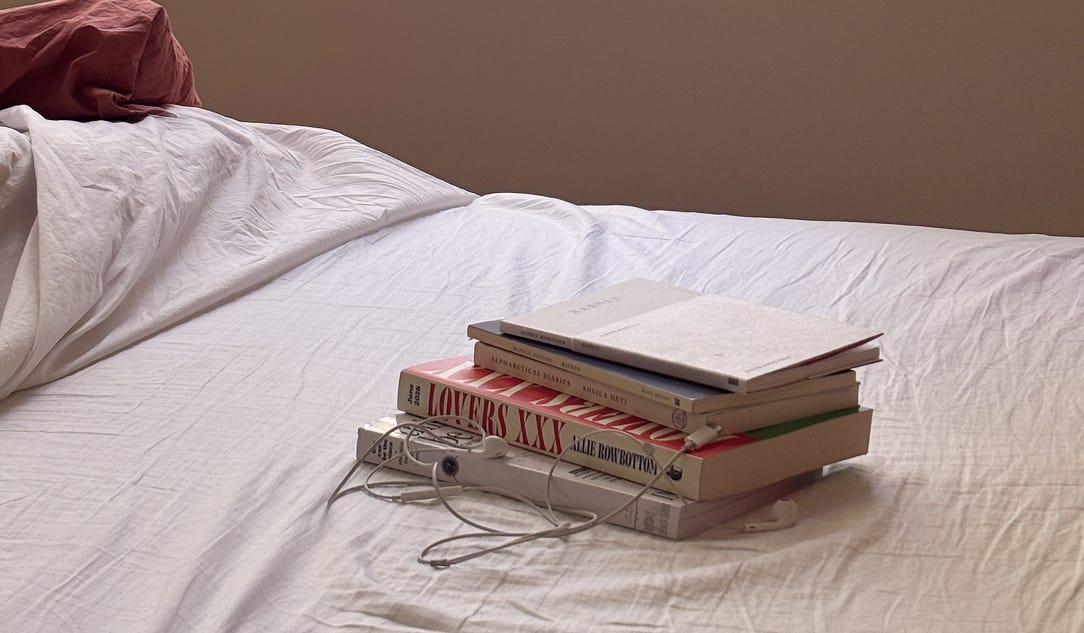
I loved this conversation 🥹 thank you so much for having me ❤️
Anyone who purchases LXXX and DMs me proof of purchase gets free admission to a writing/publishing Q&A Im doing on zoom August 30 😘