

Tech is dying to be a girl's girl
on Meta x Kylie, Phia, wellness apps, and other grifters of the new age

It’s disingenuous when women’s hearts and wallets get targeted without solicitude. Between Mark Zuckerberg x Kylie Jenner, Phoebe Gates, and most of the evidence-lacking wellness industry is not just a pool of ambition and excess cash, but the conviction that knowing our consumer habits and social media behavior means knowing us, and that our barely successful attempts to ambulate through the terrains they built for us means we like it this way, that this is our dream world. Is this our dream world, though? Is sisterhood born in the data centers? Will my life finally start making sense with this new app?

Nothing’s louder than dissonance. When I’m presented with surveillance state glasses so I can record strangers in broad daylight, a discount plugin by a bootstrapped billionaire daughter that helps me save a few dollars on a Prada bag, or a device that tells me my sleep score was bad and I need to die whenever I’ve stayed out too late, my heart cools itself with cultural stasis and soulless emptiness in lieu of excitement, and the diagnosis is clear: I feel nothing. I feel nothing when I see these ads, when I touch the products, when I’m served content churned out at industrial speeds, when I interact with the very services supposedly tailor-made and catered to my distinct needs, which are nothing but self-contradictory.
The tech industry is notoriously bad at understanding women. But since the early days of an idyllic boys’ club where no one bothered us –with the exception of the amiable mid-2010’s # female in tech archetype hardened by the harsh reality where coming into the industry with a genuine mission doesn’t get you very far– things have shifted. There’s benefit within us: since finding out that understanding us results not just in profit, but in unlocking weighty cultural leverage in the great famine of taste, we’re no longer left out of the conversation. We get seated at the big kids’ table. Now that there’s a stipulation, everyone has seemingly put “cater to the female mind” on their Monday agenda. Things get repackaged for the girls. Celebrity ambassadors. Relatable content. Little do they know the closest a corporation has come to female solidarity was Novo Nordisk, but even that arrived with a long list of side effects and an unrestricted access, so we’re still a little bit resentful about that...

Is a woman’s mind such a mystery to solve, something so untethered and convoluted, even the greatest minds of Silicon Valley remain flummoxed and intrigued? They know that a young woman, sophisticated in her choices, is both an early adopter and a market driver – they know our attention, taste, and focus matter. What do they do with this knowledge? In front of us is an astonishing spread of ideas and projections about who we are, a sort of egalitarian canvas: no one in tech knows what a woman is for sure, but no one’s bothered to understand by asking us a question.
And to configure a woman’s thinking would be to take into account everything that anchors her to reality: the body horror she experiences on the daily, propped by the platforms where she grew up as the product, the customer, and the cash cow, add vigilance of self-surveillance and an inflated sense of responsibility for everything that surrounds her, then sprinkle with frantic spending to keep her complicated feelings at bay and managed creatively. She takes notice when things feel inauthentic, feels pixelated in the night and oversaturated in the day. She is far too fearful for her future to be subsidized by a better tomorrow. She’s in tune with her devices –and by that I don’t just mean that as soon as she mentions something in passing to a friend, two hours later timely ads appear on her screen– and navigates any new product beautifully, with discernment.
She hasn’t seen her own face through the camera lens in about a decade. Since 2017, to be exact, when Apple introduces the neural engine. The camera infers and reconstructs images based on guessing, applying targeted sharpening, denoising, and other means of enhancement it perceives the photo needs. She can’t turn it off – it is the default setting. She then goes on to make decisions based on these half-real, half-imagined images the screen puts out. Changes to her physical appearance are informed by a digital interpretation of it, the same way collective Zoom dysmorphia made beauty procedures skyrocket after the pandemic. But to put blame on her for being far removed from the physical reality would be conniving, because her reality no longer stops where going outside begins, but extends into it. Her phone is where she expresses her vision, her worries, her insanity, builds a world for herself, and while it’s ruthless and addictive, it’s also the most fluent authorship she’s experienced.

Tech is a promise economy: a lot of it hinges on the potential of a big return. Most of that potential is built on veiled theories and source: trust me bro economics. Everything is future-oriented and mission-driven and any other noun-adjective duo that rarely stands for anything. But young women have learned that a big and sparkly promise is a harrowing debt to pay: the same promise economy that gave rise to girlbosses, packaging hustle culture, self-surveillance, and putting yourself through the meat grinder of ladder-climbing until your last breath can’t be the economy that makes us happy. We’re so acutely aware of the systems that have failed us, distrust is our status quo, and the body is always scanning for mismatch. I have been in many tech circles over the years, and felt both dismissed and tokenized in many. My experience is not unique.
In the grand misunderstanding, there’s two things at play: first, minimization of the psychological fallout that is growing up online. What we’ve collectively maneuvered has made us tech-savvy and ahead of the curve, sure, but also neurotic, concerned, lacking a gravity center, miserably self-preoccupied. It baffles me when they analyze our atypical behavior on the same platforms they got us hooked on. Second, a general disdain towards a young woman’s intelligence. A young woman remains an underexplored and oversimplified subject in tech: her potential is endless, her beauty is unorthodox. From there, an assumption is made that her life is devoid of pain, comprehension, and her ideas are either consumerist or male-centered, but never original. But it’s an apparition of reality, not a convincing interpretation. If I’m tormented by wanting to connect deeply, my heart doesn’t beat faster at the arrival of a new retail app. If I don’t feel safe in my body and in the world, an advanced ovulation tracker that likely sells my data and an Oura ring aren’t going to change that. I’m still unsure why this is so hard to grasp. These personalized solutions, at best useless and at worst harmful, are offensive. They’re infantilizing, they’re boring. This is why things made for a “better personal experience” further remove us from ourselves, digitizing, fragmenting, and in the end nullifying our nature, and why no significant advancement happens.
Tech doesn’t owe us understanding, but I’d respect the people in the industry more if they stopped pretending that they do. Would they be curious enough to know we’re moved by the connective and the unique, not the pristine and artificial? That our starvation for intimacy isn’t resolved by a browser extension? That there are no insatiable empty pits of nothingness inside of us like in those who hoard exorbitant amounts of wealth and push their morally flailing products onto us? That not being able to write with AI assistance means one just —maybe— shouldn’t be a writer? We’re built different. Thank god we are.
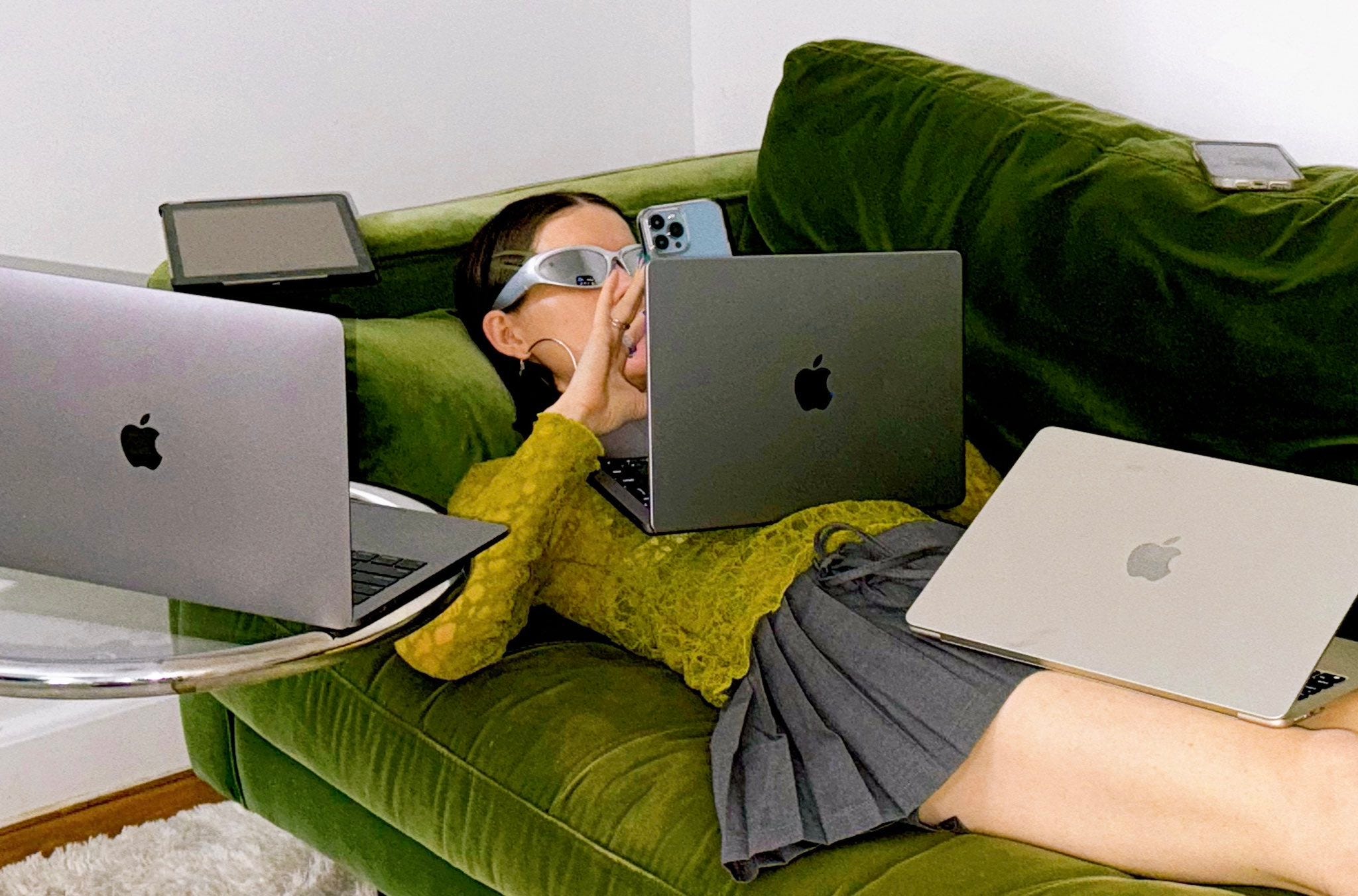
Tech prides itself on its open collective mind, but it’s just as incomprehensible to them that one wants to swim in a lake without the hungry premise of scaling it into an ocean. Some are tormented by the idea of doing something for the sake of doing it, of being in tune with one’s ego and mortal limitations, that there are things born out of simplicity and pleasure. That I may be stuck in a hazy loop of sleepless nights because I like my process grimy, slutty, hallucinatory, justified. That I wouldn’t have it any other way: I love hard and unabashed work, I love my inconsistent rhythm, talking to strangers and ugliness of the sublime. My fealty to this life, imperfect as it is, is real and true.
Under a woman’s skin is surgically implanted hatred, panic, gore, but sometimes an earnest dream, too. Both her distrust and lust for life breed a certain depth of mind, a case for brave thinking, seeing the world for what it is. This depth is so appealing to the insolent tech elite because it’s unreplicable. It’s not subject to algorithms or strategy. It drives them crazy that graceful taste remains inaccessible to them. If they wanted to claim it, they’d have to get curious enough to talk to us first.
This is so so good.
WOW wow wow - just incredible! thank your for putting (the metaphorical) pen to paper and finally saying what needs to be said